RIECKERMANN DELIVERS SAG’S LNG PROCESSING PLANT IN TUBAN
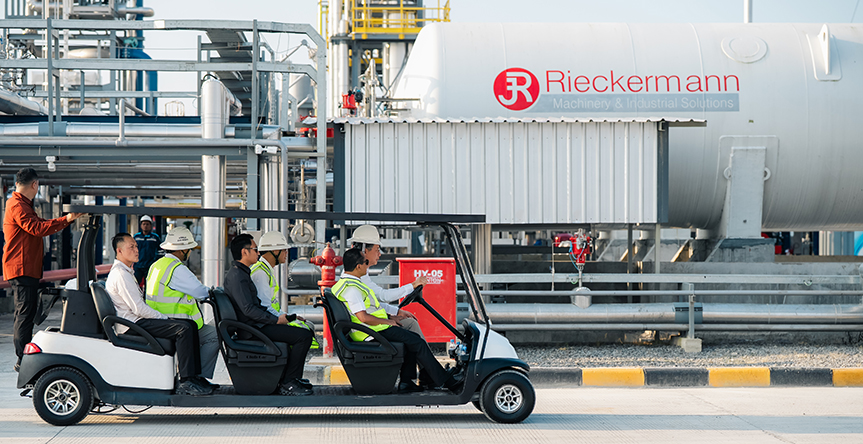

Powering Indonesia’s energy transition with Java’s largest onshore processing plant
Rieckermann is proud to deliver PT Sumber Aneka Gas’s small-scale LNG plant in Tuban, East Java, which was inaugurated on June 25, 2026, by Indonesia’s Minister of Energy and Mineral Resources, Bahlil Lahadalia.
This plant will provide a reliable baseline of energy for local manufacturers, strengthening local energy security in support of Indonesia’s broader transition toward lower-carbon fuel alternative, and help reduce Indonesia’s dependency on gas imports. “Amid geopolitical uncertainty, almost every country is optimizing all the energy potential available within its borders, no matter how small,” remarked Bahlil during the inauguration (Source: CNBC Indonesia).
The development of the small-scale LNG plant began in 2024 by PT Sumber Aneka Gas (SAG). To realize this vision, SAG partnered with Rieckermann as a full Engineering, Procurement, and Construction (EPC) contractor, entrusting the project from initial design through commissioning and operational readiness.
Navigating technical and market complexities
Developing a small-scale LNG plant in Indonesia presents a unique set of challenges:
From engineering to early operations
Successfully addressing these challenges required an experienced industrial partner with both regional knowledge and delivery capabilities. SAG drew from Rieckermann’s deep expertise in gas processing systems, modular plant concepts, and project execution in Southeast Asia:
Delivering a resilient, future‑ready energy asset
The facility possesses a nominal production capacity of 150 tons per day of LNG. This production is supported by a 1,600-cubic-meter storage tank infrastructure suited for land-based distribution. The plant is also configured to produce 18 tons per day of LPG and 8 tons per day of gas condensates.
In addition, the plant is set to manufacture compressed natural gas (CNG) at a capacity of 6 million standard cubic feet per day (MMscfd). These outputs will enable more flexible gas distribution to industrial users, supporting cleaner fuel adoption and reducing reliance on higher-emission alternatives.
“With the operation of PT Sumber Aneka Gas’ Mini LNG Plant facility, we are ready to take further steps and support the Asta Cita program of President Prabowo Subianto by increasing the added value of national natural resources, strengthening Indonesia’s energy security, and ensuring that national industries continue to grow with reliable and cleaner energy supplies,” said Agustus Sani Nugroho, President Director of SAG (Source: SAG).
The major engineering deliverables and commissioning have been completed by Rieckermann, with both basic and detailed engineering designs laying a strong technical foundation for safe, efficient plant operation.
A blueprint for the future of energy in Southeast Asia
The Tuban LNG project stands as a strong example of how industrial expertise, regional understanding, and collaborative execution can turn complex energy ambitions into reality. As construction progresses toward completion, industry players like SAG are empowered to thrive in a rapidly evolving energy landscape through Rieckermann’s commitment to delivering safe, efficient, and future‑ready solutions.
President Director of Rieckermann Indonesia, Stefan Pfingsttag remarked: “The plant features a customized process design specifically engineered for the client’s gas source composition, while maintaining a modular architecture that allows replication across other locations where small-scale LNG is viable including markets such as Malaysia, Vietnam, South America, and Africa. This dual approach of tailored gas processing with modular plant design enables rapid deployment and adaptation to varying feedstock conditions, integrating LNG, LPG, and natural gas condensate processing in a compact, relocatable footprint.”
The Tuban LNG plant represents more than a successful project. It is a replicable model for addressing one of Southeast Asia’s most pressing challenges: delivering cleaner energy at scale, beyond traditional infrastructure limits.
As Indonesia continues its energy transition, projects like this will play a critical role in shaping a more resilient, efficient, and sustainable energy system. Through their combination of engineering expertise, regional understanding, and end-to-end execution capability, Rieckermann is not only delivering infrastructure, but enabling the next phase of industrial and energy transformation in the region.


 RIECKERMANN HIGHLIGHTS OSD SOLUTIONS AT CPHI CHINA 2026