RIECKERMANN ENABLES WASTE-TO-ENERGY PROJECTS IN INDIA THROUGH THEIR ECA-COVERED FINANCING SERVICE
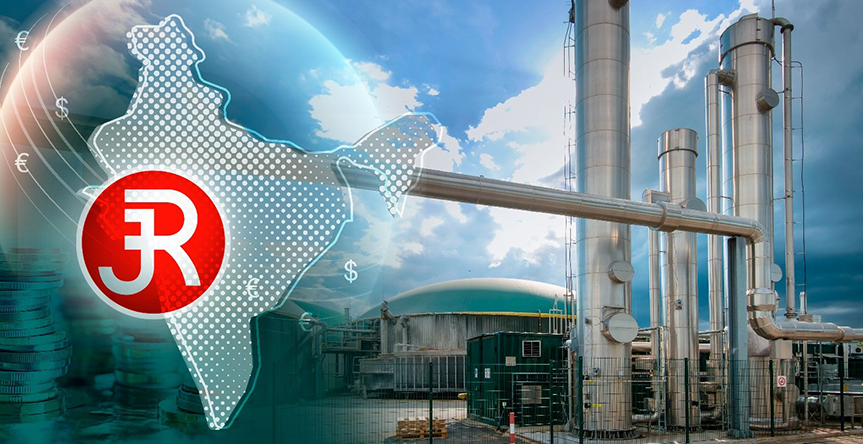

Rieckermann is thrilled to have facilitated CEF Group India’s investment into a state-of-the-art compressed biogas (CBG) plant by providing ECA-covered structured financing solutions. Contracting and initial implementation steps for CEF Jammu Energy Private Limited have been completed in close partnership with AKA Ausfuhrkredit-Gesellschaft mbH. The second project, CEF Ahmedabad Cleaneffentech Private Limited, is well-prepared and expected to follow shortly.
In both cases, Rieckermann has been commissioned to act as project manager and general supplier of engineering, equipment, and project-related services alongside the structuring and arrangement of long-term financing with export credit agency (ECA) support:
The new facilities will be processing up to 850 metric tons of municipal solid waste (MSW) into compressed biogas (CBG) per day, which is a renewable, high-energy fuel that can be used to substitute diesel, petrol, and natural gas. The process will also generate valuable by-products such as organic manure, refuse-derived fuel (RDF), and city compost, contributing to a circular and sustainable urban waste economy.
These jointly driven projects support India’s energy security and reduce imports of fossil fuels and chemical fertilizers at the same time, while strengthening local rural economies.
“Our immediate focus is to ensure the successful execution of these two plants: Jammu and Ahmedabad. Once stabilized, we aim to replicate this model in other parts of India and abroad to accelerate the clean energy shift,” said Maninder Singh Nayyar, Founder & CEO of CEF Group.
“We are proud to contribute to the resilient infrastructure development in India, supported by international cooperation and effective structured export finance,” says Micha Christian Haercke, Head of Global Trade Finance at Rieckermann.
Planning an industrial investment and exploring financing options? Get in touch with our Global Trade Finance team at https://rieckermann.com/en/contact/
How can project owners and investors benefit from Rieckermann’s Global Trade Finance solutions?
Rieckermann’s Global Trade Finance solutions help project owners and investors realize large industrial investments while limiting upfront capital requirements and preserving working capital and domestic credit lines.
For eligible projects, Rieckermann can facilitate access to long-term financing from international banks, typically covering up to 85% of project costs, with repayment periods ranging from five to twenty years. Supported by international export credit agencies (ECAs), financing can be structured around individual project schedules, with repayments commencing only after commissioning, enabling the asset to generate revenue before debt servicing obligations arise.
Is Rieckermann’s Global Trade Finance service available in other countries and industry sectors?
Yes. Rieckermann supports eligible industrial projects across Asia, the Middle East and Africa, combining financing expertise with engineering, technology, and project implementation capabilities.
Beyond our existing industry scope, Rieckermann draws on a broad network of specialized partners, financial institutions, and export credit agencies to structure financing solutions tailored to each project’s specific requirements. This enables Rieckermann to support effective all industrial development projects that are eligible for export credit agency (ECA) financing.
Eligibility and financing conditions depend on factors such as the country, industry, technology, and project structure. Sustainable or green projects may even qualify for enhanced conditions under certain ECA programs.
When is the best time to engage Rieckermann’s Global Trade Finance team?
Ideally, financing should be considered early in project development. This allows technical, commercial, and financing requirements to be coordinated from the outset and provides greater clarity on project economics, budgeting, and future repayment obligations.
However, Rieckermann may also be able to support projects that are already underway, depending on the project structure and schedule. In certain cases, existing procurement and financing arrangements can be restructured, reimbursing investors for Letter of Credit (L/C) payments already made.
How can projects like these contribute to India’s green transition and economic growth?
Projects such as these compressed biogas plants can support India’s green transition by converting municipal solid waste into renewable energy, reducing landfill volumes, and creating a domestic alternative to fossil fuels. They can also generate useful by-products such as organic manure, refuse-derived fuel (RDF), and city compost, contributing to a more circular use of resources.
Beyond their environmental benefits, such projects can strengthen energy security and support local infrastructure and economic development. Rieckermann helps facilitate complex investments of this kind by coordinating technology and service providers, financing partners, banks, and export credit agencies within an integrated project structure. This reduces administrative effort, complexity, and risk for all parties, facilitates investor’s access to financing by improving transparency, and allows all stakeholders to benefit throughout the project lifecycle.